Spotlight Oklahoma: Where intervention meets innovation
In Oklahoma, schools are blending innovation with intentional literacy intervention to help students accelerate their reading growth and build deeper confidence. By combining targeted support with research‑aligned practices, learners are making meaningful progress and teachers are equipped to sustain success.

District Snapshot:
- Hughes County, southeastern Oklahoma
- 300 students
- K-8: 160 kids
- 40% minority enrollment
- 44% are eligible for free and reduced lunch
When Moss Public Schools Superintendent, Robin Gann, came to then 2nd grade teacher Kimberly Rosenow to ask her if she would step into the reading interventionist position at Moss Elementary, Rosenow wasn’t sure she was the right person for the challenge. The small rural elementary school in southeastern Oklahoma’s Hughes County had several challenges. With 40% minority enrollment and 44% of students qualifying for free and reduced lunch, meeting the diverse literacy needs of the K-3 students would require a strategic and personalized approach.
But Gann knew Rosenow was built for this challenge. “Kim’s one of those people who puts her all into it. It’s her passion.”
Eventually, Rosenow agreed—knowing she already had LETRS training to help support her depth of knowledge and experience.
“Last year was my first year as an interventionist, and I was struggling to meet each student exactly where they were,” Rosenow explains. “I felt like I was teaching to the middle, and our most vulnerable learners were being left behind.”
A targeted solution
Rosenow’s search for a more effective intervention strategy led her to 95 Percent Group’s comprehensive One 95 Literacy Ecosystem™— and in particular to Tier 2 solution 95 Phonics Lesson Library™, and Tier 3 solution, 95 RAP (Reading Achievement Program)™. Both programs offered the differentiated support she knew her students desperately needed.
“I was looking for something that could personalize instruction for our Tier 3 students,” she recalls. “With 95 RAP, I discovered a solution that was both teacher-led, digital, and could meet each kid exactly where they were instead of leaving them behind.”
Transformative impact
It was kind of hard for me to wrap my head around. I thought, there’s no way one program can do that—actually tie in phonics and phonological awareness, fluency, comprehension, and spelling. There’s just no way it can do all of that. But once I implemented the program, it blew my mind. It absolutely blew my mind how effective it was and how engaged all my students stayed the entire time.
Kimberly Rosenow
The results were immediate and profound. A particularly compelling success story emerged with a 2nd grade student who arrived in September significantly behind his peers. Unable to recognize the entire alphabet and struggling to read, the student seemed discouraged.
By March, everything had changed. “He passed his first High-Frequency Word list and mastered CVC words,” Rosenow says. “The day he completed the entire list, his reaction was priceless. I remember him saying, ‘I just got my 3rd star!’ His confidence has absolutely soared.”
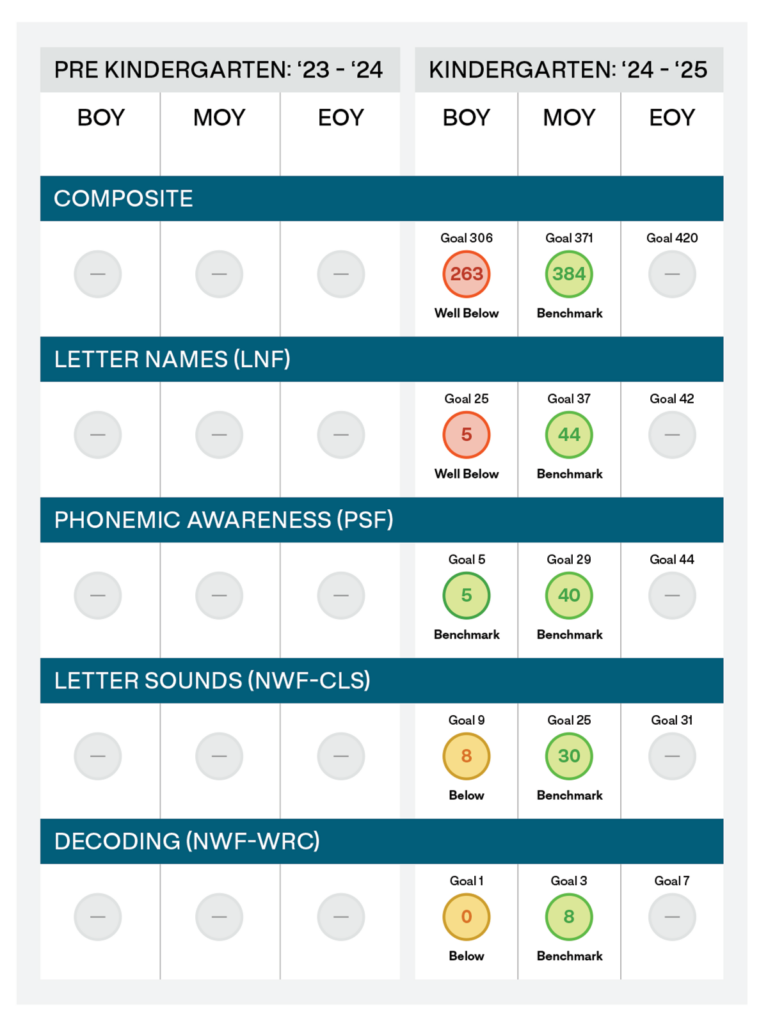
Rosenow had several students who began the year in a Tier 3 intervention group, requiring the most intensive strategic intervention. “By the middle of the year,” she said excitedly, “most were meeting some if not all of the DIBELS benchmarks for their grade level—one was even able to move out of intervention altogether!”
Gann seconded this impact. She recalls first being in classrooms after implementing 95 RAP.
“All I could say was Wow! It is the best thing we could have done. I don’t get to observe very often and, but I’ve gotten to see the progress our students are making first hand. I’ve been telling other people. We’re sharing about our success.”
95 Percent Group’s approach to professional development is critical to its success. “The way they [95 Percent Group coaches] train and provide coaching is exceptional,” Rosenow emphasizes. “The feedback—both constructive and positive—has been incredibly supportive.”
Gann doubles down on this. “Our 95 Percent Group coach has been there any time Kim needed her. The support has been incredible. This part is a big deal for us providing daily and weekly support. Coaching has been a really different experience, and such a big part of our success.”
Gann continued, “Every one of my elementary teachers is trained in the science of reading now. When I sit in the classroom and watch, they are learning the rules. I don’t remember hearing that when I was in school. When you know the rules, everything becomes easier.”
More than just numbers
The program’s impact extended beyond individual student achievements. Rosenow noticed a remarkable shift in overall student engagement. “Now, when I appear at the classroom door, students jump up, excited to work with me,” she says. “Every single one of them is eager to participate, and it’s a big change, and a really big deal.”
There is so much importance put on scores and student gains to show progress, but the whole reason these scores are important isn’t just that the numbers are improving; it’s in what that represents. Yes, a student hitting literacy benchmarks is something to celebrate. But, when a student starts the year anxious or unhappy or feeling down on themselves because not only is reading hard, but they really don’t enjoy it, and then begin showing up to school excited to read, that’s the real transformation. Maybe it sounds dramatic, but it can truly change a student’s trajectory.
A message of empowerment
The data tells a compelling story. At mid-year assessments, significant growth is already evident. Of four first-grade students in intervention, one has already reached benchmark, while two others are just a point or two away. Students who once struggled are now reading with newfound confidence and skill.
But perhaps most importantly, Rosenow has instilled a powerful mindset in her students: “We can do hard things.” It’s a motto that encapsulates the journey of growth, resilience, and academic achievement at Moss Elementary.
As educators across the nation continue to search for effective ways to support struggling readers, Moss Elementary offers a different path. Rosenow’s approach demonstrates that meaningful change is possible with the right tools, unwavering commitment, and a belief in student potential.
“We’ve got to trust the process for a couple of years,” she reflects. “But the results speak for themselves. We’re not just teaching reading—we’re building confident, capable learners who believe they can overcome any challenge.”
Looking to the future: A ripple effect
Rosenow’s work extends far beyond individual student achievements. She’s creating a systemic approach to literacy that promises to reshape educational outcomes for an entire community. Weekly meetings with Moss Public Schools superintendent Gann, armed with progress monitoring reports and growth graphs, illustrate a district-wide commitment to educational excellence. Gann receives weekly updates, complete with progress monitoring reports and growth graphs that tell a compelling story of transformation.
Rosenow’s long-term vision is ambitious. “In three years, I believe the number of students I’ll need to pull for intervention will be almost none,” she explains. Gann agrees. “If we are aligning all of our instruction, we should be able to see the outcomes and the change we are wanting. I can’t wait to see where we are in 3 years from now.”
Moss Elementary stands as a testament to what’s possible when innovative tools meet passionate educators. In the end, Rosenow is so happy she took on this position and the challenges it brought. “We’re laying the groundwork for a future where every child can read with confidence and joy.”
Ready to learn more? Contact a literacy specialist today!

Bring this success story to your team
Download this literacy transformation story and share with district leaders, literacy teams, school administrators, and instructional coaches.